
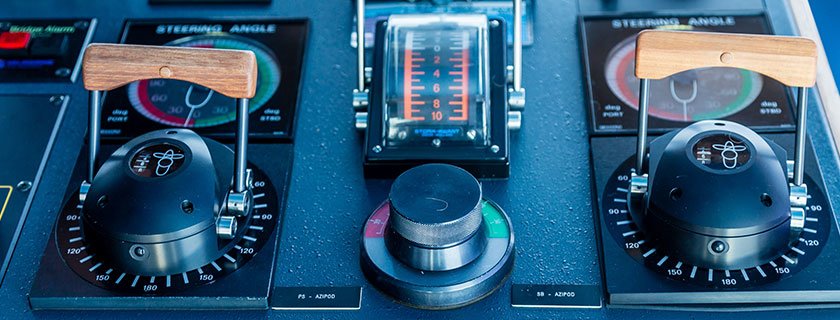
The project focused on defining system requirements and designing a CAN-based control system capable of tolerating a single point of failure while maintaining operational performance
TK Engineering developed a CAN-based water jet control system for a leading water jet manufacturer operating in the marine industry. In 2016, the customer contacted TKE to modernize its existing water jet control system.
Modernizing a marine water jet control system
The customer had reached a limit in their control system, which made producing in large quantities time-consuming. Together with the customer, TKE defined the requirements for a new control system needs to replace the old system and would retain all existing functionality while enabling faster manufacturing with fewer man-hours.
Meeting marine classification requirements
TKE began the project by gathering system requirements and proposing a next-generation control system architecture. The new control system was designed for maritime-classed high-speed passenger workboats, which required compliance with strict marine industry standards. Marine classification bodies also defined several key technical and safety requirements for the system.
One of the most important requirements was fault tolerance. The control system shall tolerate single point of failure without degradation in performance. To accomplish single point of failure without degradation all inputs, process and outputs was made redundant.
The team implemented the system’s process control using a rugged mobile PLC designed for demanding marine environments. To maximize code reusability and avoid dependency on a single hardware supplier, they selected CoDeSys 3.5 as the software platform. To reduce installation costs and simplify cabling, the system uses CANopen communication for the Human Machine Interface (HMI).
J1939 based IO was used
The system uses J1939-based I/O for engine interfacing, creating a more future-proof and flexible architecture. This approach allows customers to retrofit J1939 or NMEA 2000-enabled engines and integrate engine diagnostics and control directly into the existing control system.
Because the J1939 network already exists within the system architecture, future engine integrations can be implemented efficiently by simply connecting the engines to the existing network.
Strengthen our know-how on marine-applications
TKE used CANopen communication to reduce cabling and improve diagnostics while meeting the customer’s goals for lower installation costs and better serviceability.
“The solution also creates opportunities for future expansion, including additional control stations, vector steering, and dynamic positioning functionality, without requiring major redesign of the existing control system”
Bertil Bäck, Manager of the HW development at TKE
”This project gave us a great opportunity to strengthen our know-how even more on marine-applications” says TKE CEO Timo Kesti and continues: “Developing a Maritime classed control system from the ground demands experience in both hardware and software which is exactly what we are focusing on”